Research questions
In response to changes in the urban environment, animal and plant populations and communities rearrange, accommodate, and/or adapt. Understanding the processes leading to these different responses is essential for designing more ecological and resilient buildings, neighborhoods, and cities.

Three research hypotheses
Study sites
The project, which began in 2020, aims for the long-term monitoring of biodiversity in 60 urban herbaceous sites throughout the metropolitan area of Strasbourg (Eurométropole de Strasbourg). These spaces are distributed across a variety of urban forms and are subject to different degrees of management. Given that the response of biodiversity can vary depending on the species' position in the food chain and its sensitivity to various environmental factors, we are simultaneously monitoring plants, insects, birds, and bats. Among our many hypotheses, we assume that plants primarily respond to local factors such as soil properties, management practices, or human presence. In contrast, insects, birds, and bats are likely more dependent on landscape-scale factors. Additionally, we hypothesize that light pollution primarily affects bats, while noise pollution mainly impacts birds.
 Distribution of Evolville study sites
Urban gradients analyzed
Landscape variables - The urban landscape is described using four complementary indicators, calculated within different radii around each site based on high-spatial-resolution datasets. These landscape indicators were selected for their ability to synthetically represent the urbanization gradient and human density, as well as their potential to explain local variations in biodiversity. They include: average building height, average nighttime luminance, and the proportions of herbaceous and woody vegetation.
Management variables - The management practices applied on the herbaceous vegetation stratum at each site are recorded annually through an active dialogue with site managers. These include the mowing period (early, summer, late, year-round), mowing frequency per year (ranging from 0 to 16), mowing type (cutting or mulching), and whether cuttings are removed or left on-site.
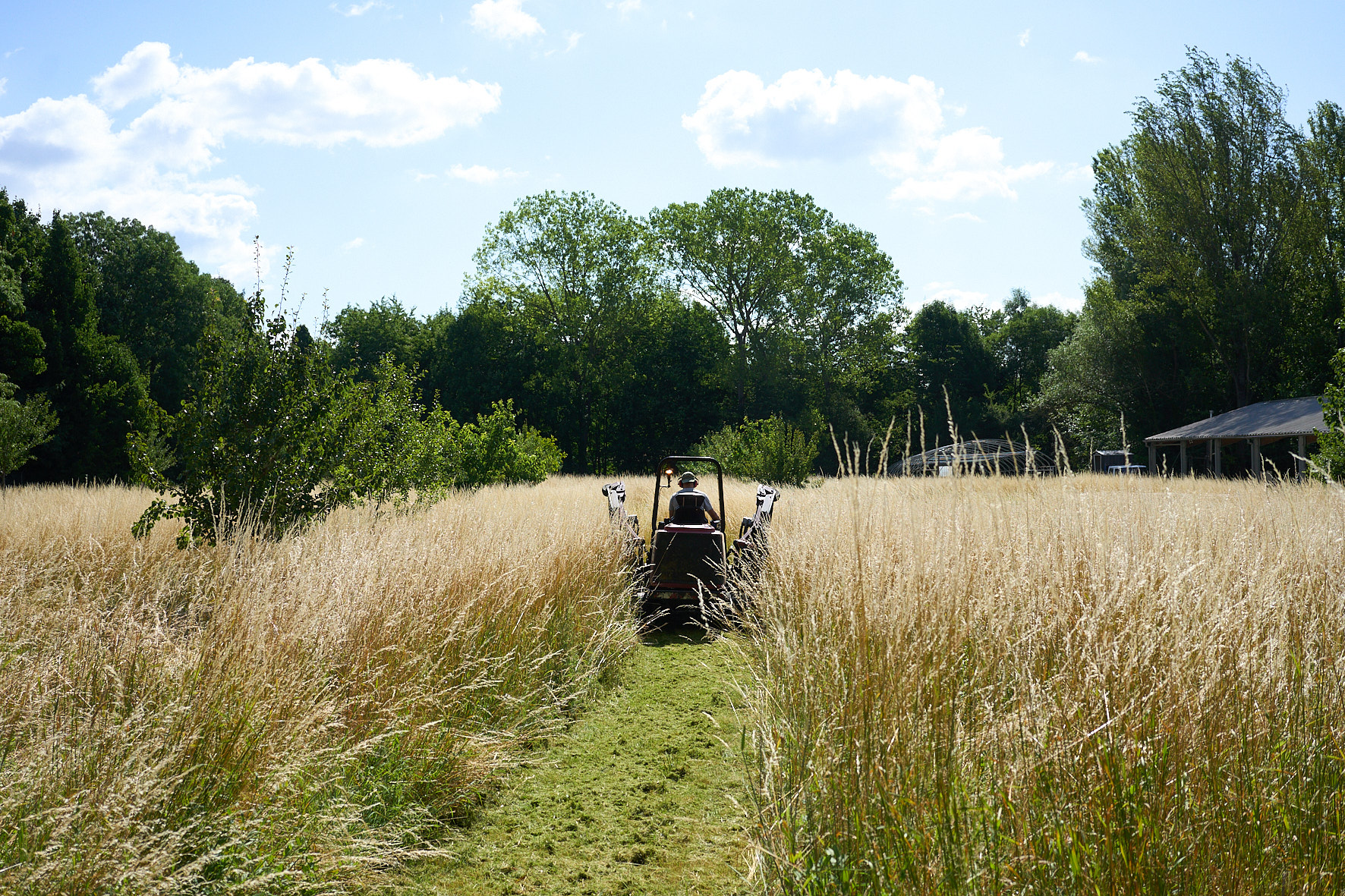 Mowing of a pathway in the CNRS Cronenbourg Campus orchard © Audrey Muratet
Soil parameters - Each site underwent a detailed soil characterization using a hand auger survey to the full soil depth (until an obstacle was encountered). The different soil horizons were described in terms of color, dominant texture, coarse element content, and potential signs of hydromorphy. The soil's available water capacity — i.e., the maximum amount of water it can retain — was estimated based on depth, texture coefficient, and coarse element content. Three soil samples were collected from the surface horizon (20 cm) for laboratory analysis of particle size distribution and fertility. Soil compaction was assessed by measuring bulk density using three cylinder samples taken at the surface to calculate the ratio of dry soil weight to volume.
Local climatic variables - In 2022, temperature and humidity sensors were installed at all sites with consistent orientation and height. Temperature (with a resolution of 0.5°C) and relative humidity (with a resolution of 1%) are recorded hourly and continuously.
These gradients of urban form, mowing practices, and environmental conditions will allow us to determine how urbanization affects plant and animal communities. We compare the taxonomic and functional compositions of these sites and conduct more detailed monitoring of certain species in the field and in a botanical garden through morphometric and genetic analyses.
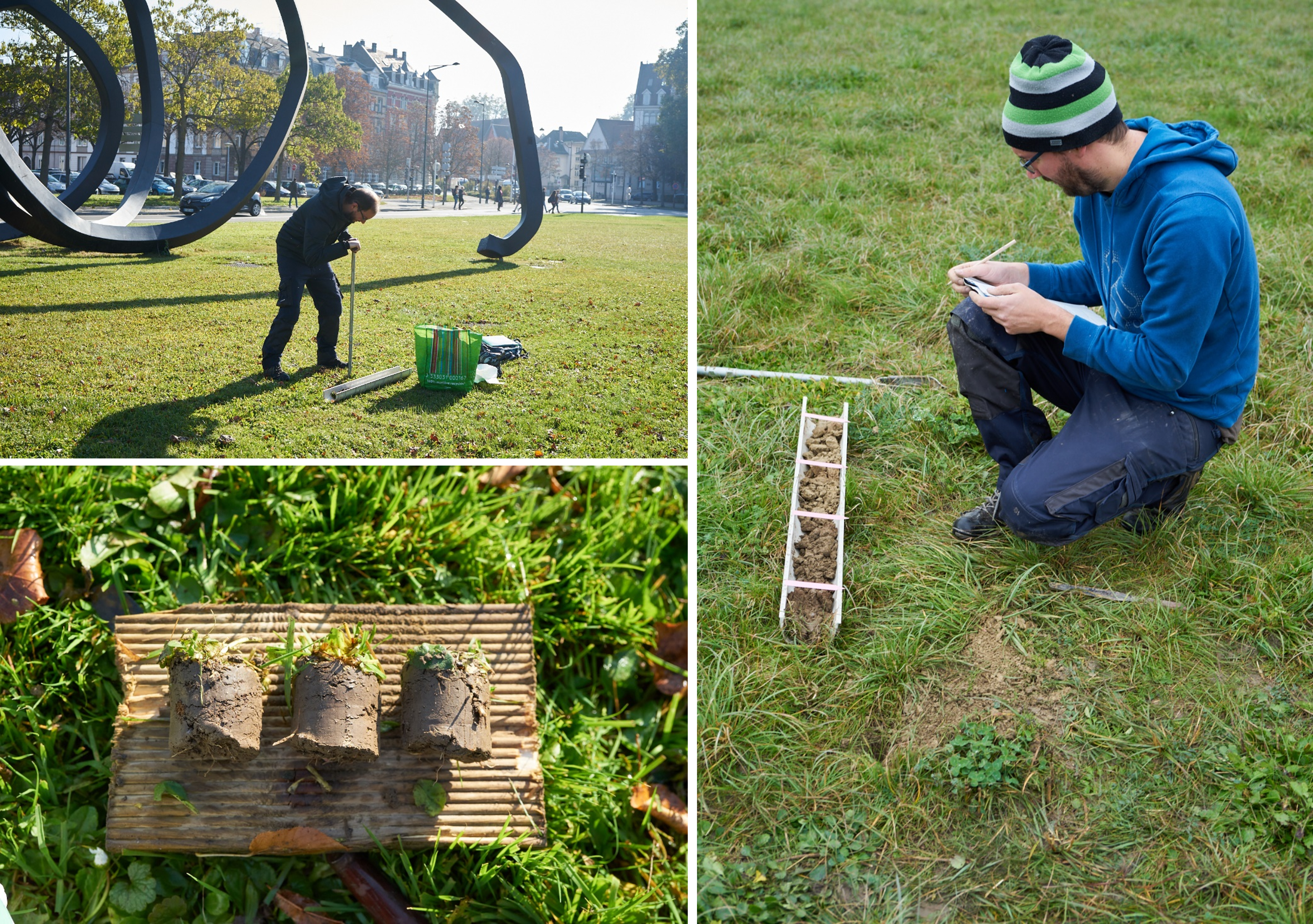 Soil analyses conducted by Étienne Chanez. © Audrey Muratet
Studied taxa
Vascular plants - Standardized surveys have been conducted annually since 2020 in June-July, using 15 permanent 1 m² quadrats at each site. The species present within these quadrats, along with their phenological stage (vegetative, flowering, fruiting, or dry), are recorded each year. In 2021, additional phenological surveys were carried out at 14 sites, monthly from April to September on the same quadrats. In 2024, exhaustive surveys were conducted in June-July across all sites, inventorying the entire herbaceous area to ensure that rare species that might be missed by standardized surveys were recorded. Trait measurements were taken for four species: ribwort plantain, Plantago lanceolata L., black medick, Medicago lupulina L., orchard grass, Dactylis glomerata L. and red clover, Trifolium pratense L. We measured leaf thickness, plant height, flower size, seed weight, and germination rate for five individuals per species per site. Measurements were taken in the field in 2021 (in situ) and at the botanical garden in 2022 (ex situ) on individuals grown from seeds collected in the field.
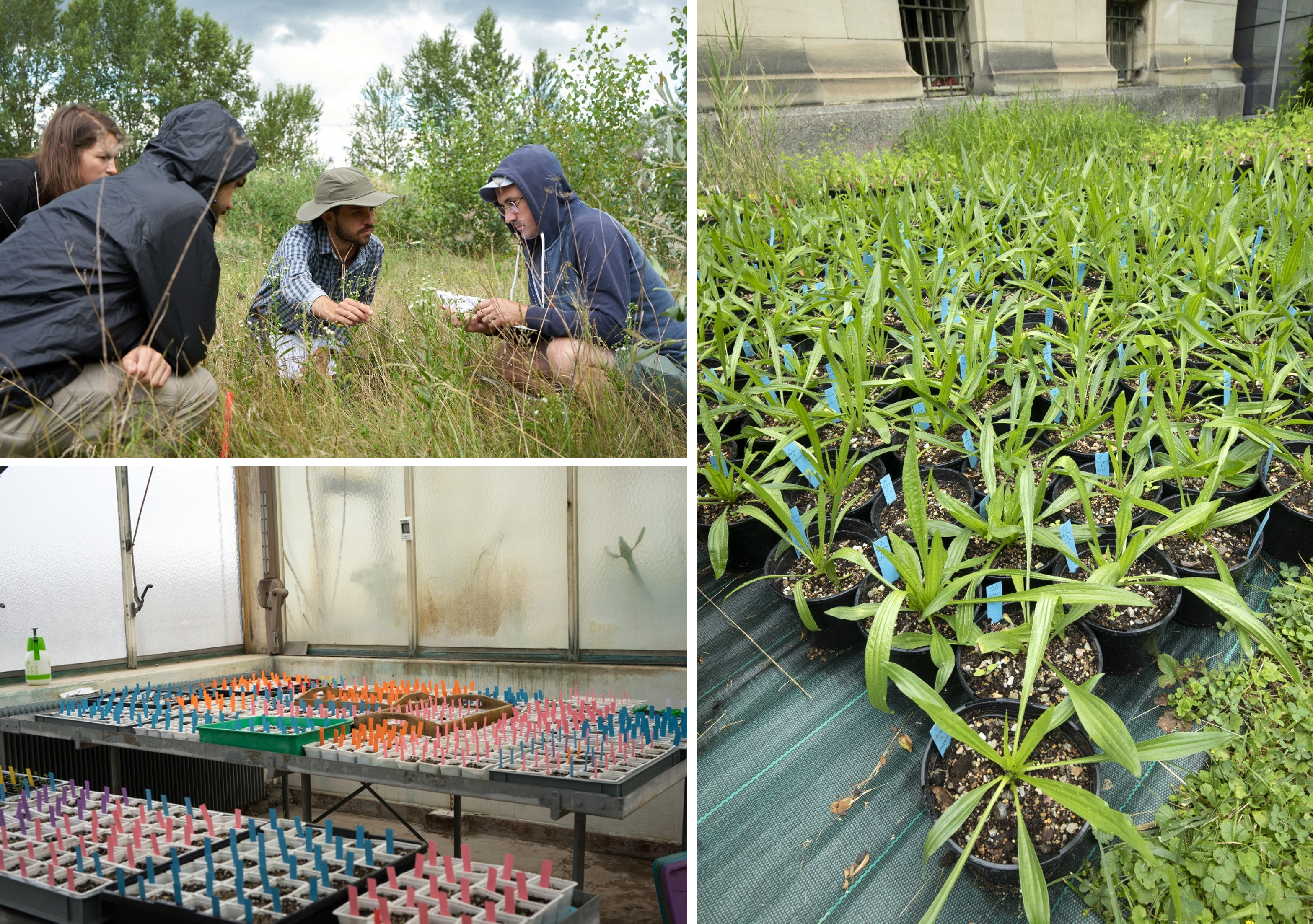 Top: Floristic field monitoring with Laurent Hardion, Eric Weissgerber, Marine Langlois, and Enzo Jugieau. Bottom and right: Greenhouse and garden cultivation of the four model species. © Audrey Muratet and Frédéric Tournay
Birds - For each site, two 5-minute point-count inventories are conducted annually, beginning in 2024. Each point-count involves recording all species and individuals detected by sight or sound within a 100-meter radius of the observer. The first survey takes place in early spring (early to mid-April) to capture early-nesting species, and the second in late spring (early to mid-June) to detect late-nesting species. In 2024, direct listening was supplemented with passive acoustic recorders (AudioMoth devices) to refine the species list per site.
Bats - Beginning in 2024, bat acoustic sampling is done by recording the ultrasonic calls emitted by bats for echolocation and insect hunting. The protocol involves placing a passive recorder (AudioMoth device) at approximately 2 meters high at the edge or center of each site for two consecutive nights. To cover the bats' biological cycle, recordings are repeated four times (April, May, June-July, and September), totaling eight nights of recording per site. Species identification is performed by the Tadarida sound classification algorithm (source: Vigie-Chiro programme) and filtering for the most likely species.
Solitary bees and wasps - Trap nests (also known as “bee hotels”) have been placed at each site since April 2022, and their occupancy rates are monitored throughout the year. During spring 2026, all trap nests were gathered and stored inside individual and ventilated plastic boxes at the Botanical Garden of the University of Strasbourg. All emerging adults, as well as any other arthropod taxa present, were identified and recorded.
Mosses - Exhaustive surveys for bryophytes were conducted in 2024 between February 15 and March 27, exploring each site along a centripetal spiral path for a maximum of two hours and across various substrates, including soil, rocks, tree bases, rotting wood, and debris. Standardized surveys were also carried out in June-July 2024 within the same 15 1 m² quadrats used for vascular plant monitoring.
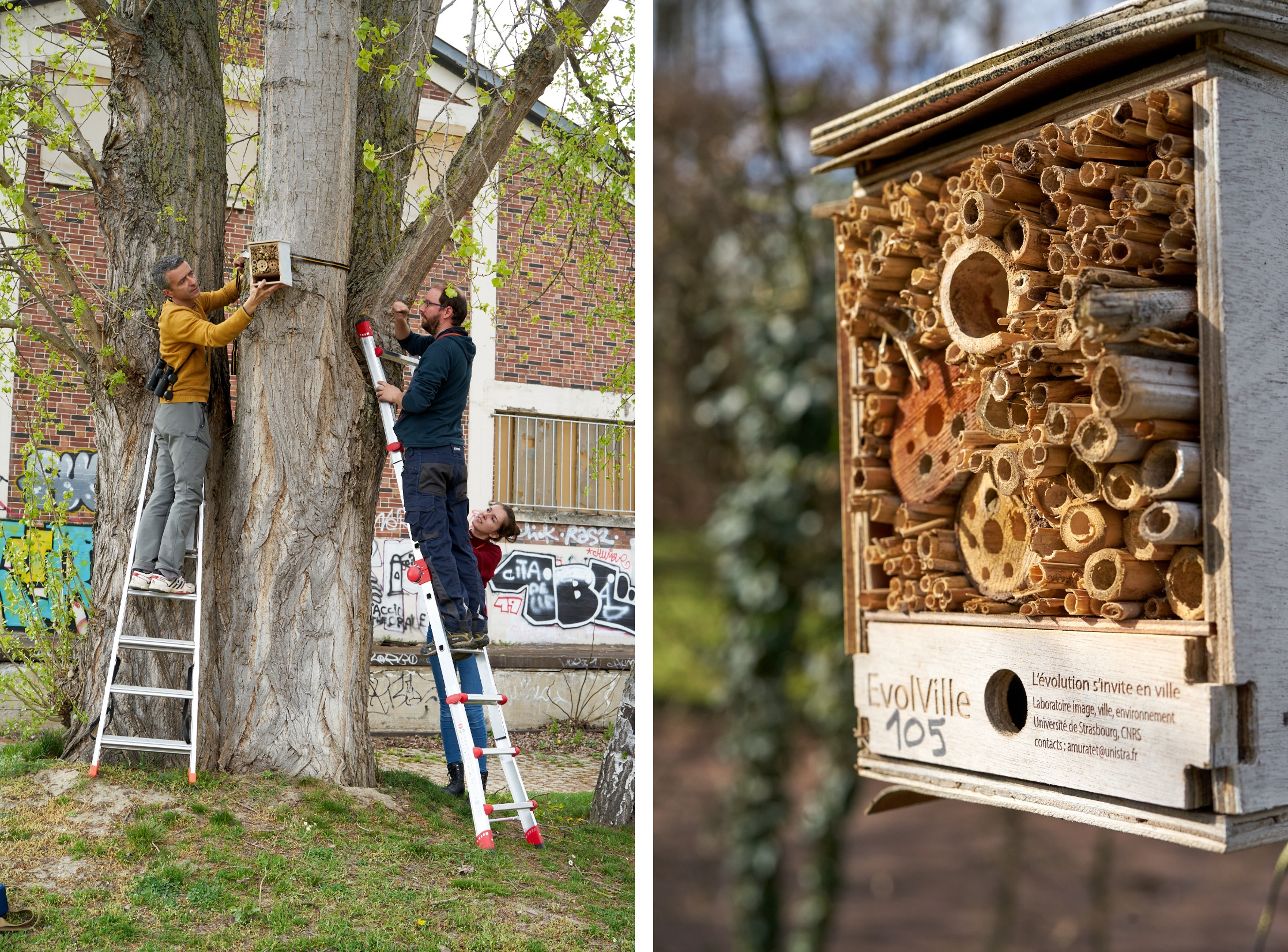 Left: Installation of a trap nest by François Chiron, Étienne Chanez, and Manon Guillaume-Thouvenin. Right: Trap nest © Audrey Muratet